Growing SB NRI Tax 4X in six months
A plan to take SB NRI’s tax and compliance line from ₹3.56 cr a year to a ₹14.24 cr run-rate by June 2027: the customers, the services and prices, a working financial model, the growth levers, a live dashboard, and the first 90 days.
An independent case study by Harsh Gandhi. SB NRI facts come from its public pages as of 9 October 2026. SB NRI’s internal numbers were not available, so the baseline, costs and growth rates are my estimates (stated in the model’s Assumption Log), and the dashboard data is made up. Nothing here is tax, legal or investment advice. © 2026 Harsh Gandhi. All rights reserved: please do not copy or republish without permission.
SB NRI Tax grows 4X: the plan in one page
SB NRI Tax grows 4X in six months only if five things work together: bring last year’s customers back, sell tax help to the people who already hold SB NRI wealth products and app accounts, open a proper web checkout, add services for the moments that matter, and reach new NRIs through search and partners. Customers grow from 6,500 to 16,773, and the average order from ₹4,422 to ₹6,555.
The margin is thin on purpose (about 2.4% above the bar), so the dashboard in Part 6 and the first 90 days in Part 7 are built to find out early whether it is working.
The seven parts
Customers and positioning; services and prices; the model; the levers; the top five initiatives; the dashboard; the 90-day plan.
The live dashboard
Part 6 is a working weekly dashboard with 27 KPIs. Pick a week and click any KPI.
The Excel model
Part 3 embeds the model, view only, with every formula visible.
What this plan assumes, stated up front
SB NRI’s internal numbers were not available to me. Today’s revenue, customers and margin are built bottom-up from public pages, the assignment brief and stated estimates. Read this part first: if an assumption here is wrong, the numbers after it move.
Every assumption has a status, the same one it carries in the model’s Assumption Log: given in the brief, sourced from a public page, agreed as a working figure, decided by me as a choice, or an estimate to be replaced with real data in the first 30 days.
How today’s revenue of ₹3.56 cr is built
Seven services, each with an estimated 2026 order count and the price SB NRI realised after GST.
| Service | 2026 orders | Realised price | Revenue, ₹ lakh | CA / CPA fee an order |
|---|---|---|---|---|
| Indian ITR (one price in 2026) | 3,000 | ₹3,500 | 105.0 | ₹900 to ₹2,500 |
| US return (1040) | 600 | ₹14,500 | 87.0 | ₹6,000 |
| PAN services | 2,500 | ₹3,500 | 87.5 | ₹1,200 |
| Form 145/146, repatriation | 1,200 | ₹3,000 | 36.0 | ₹1,200 |
| Lower TDS certificate | 150 | ₹15,000 | 22.5 | ₹5,000 |
| Tax consult (30 min) | 400 | ₹3,000 | 12.0 | ₹1,000 |
| Tax notice, routine | 200 | ₹3,000 | 6.0 | ₹1,000 |
| Total | 8,050 | 356.0 |
Status: sourced and estimated. Order counts are sized from SB NRI’s public pages (“10,000+ returns filed”, “10,000+ PAN cards”, 642 reviews for Form 15CA/CB, 512 reviews for US filing). Prices come from the site FAQ (ITR ₹4,000 to ₹7,000) and App Store listings (US return ₹12,900 and ₹19,900; PAN ₹3,999). CA and CPA fees are benchmarked against public rate cards.
How 6,500 customers are counted
About 8,050 orders at roughly 1.24 orders a customer gives 6,500 paying customers. The split by source is my estimate; paid customers are ₹36 L of marketing divided by a ₹2,500 cost per customer.
| Where 2026 customers came from | Customers |
|---|---|
| Repeat customers | 1,950 |
| Wealth customers who also buy tax help | 1,200 |
| Existing app users | 1,910 |
| Paid digital (new) | 1,440 |
| SEO and content (new) | 0 |
| Partners (new) | 0 |
| Total | 6,500 |
Status: estimate. This split is the first thing to check against real data.
How the 8% margin is reached
From ₹356 L of revenue down to ₹28.6 L of EBITDA, one line at a time. Dark bars are subtotals; grey bars are costs.
| 2026, ₹ lakh | Amount | Share of revenue | % | How it is assumed |
|---|---|---|---|---|
| Revenue | 356.0 | 100% | Orders × realised 2026 prices, after GST | |
| CA / CPA fees | (129.8) | 36.4% | A fee per order for each service (see the table above) | |
| Gross margin | 226.3 | 63.6% | ||
| Payment gateway | (10.5) | 2.9% | 2.5% of the amount collected, GST included | |
| Support | (12.1) | 3.4% | ₹150 an order × 8,050 orders | |
| Refunds | (10.7) | 3.0% | 3% of revenue | |
| Marketing | (36.0) | 10.1% | ₹3 L a month | |
| Contribution margin | 157.0 | 44.1% | ||
| Team | (98.4) | 27.6% | ₹8.2 L a month: Head of Tax, 3 tax associates, 3 sales advisors, 2 operations | |
| Technology | (18.0) | 5.1% | ₹1.5 L a month | |
| Tools and software | (6.0) | 1.7% | ₹0.5 L a month | |
| Other operating costs | (6.0) | 1.7% | ₹0.5 L a month | |
| EBITDA | 28.6 | 8.0% | ||
| Income tax | (7.1) | 2.0% | 25% of profit; no depreciation, technology is expensed | |
| Net profit | 21.4 | 6.0% |
Status: agreed working figures, with the team cost built from today’s nine people. Gross margin 63.6%, contribution margin 44.1%, EBITDA margin 8.0%.
Business as usual (BAU): what happens if nothing changes
BAU is the yardstick the 4X plan is measured against. It assumes SB NRI keeps doing what it does today, with no new services, channels or hires.
| BAU assumption | Value | Status |
|---|---|---|
| Growth on 2026 | +30% a year, spread over the same monthly season | Decided |
| Prices and services | The same seven services at 2026 prices; average order stays ₹4,422 | Decided |
| Customers | 8,450: every 2026 source grows 30% (repeat 2,535, wealth 1,560, app users 2,483, paid 1,872). No SEO or partner channel | Estimate |
| How orders are sold | 60% still need a sales advisor to close | Estimate |
| Delivery | 15 external CAs and CPAs; minimum team of 3 associates, 3 sales advisors and 2 operations | Estimate |
| Fixed costs | Technology ₹1.5 L, tools ₹0.5 L and other costs ₹0.5 L a month, unchanged | Agreed |
| Wealth discount, new hires | None | Decided |
What BAU produces in 2027: revenue of ₹4.63 cr, EBITDA of ₹0.68 cr (14.6%), and a season-adjusted multiple of 1.30x, well short of 4X. The CA network also runs at 110% of capacity in July, so BAU does not hold up in season even before any growth plan.
The 4X plan: what changes from BAU
| Input | Today / BAU | 4X plan | Note | Status |
|---|---|---|---|---|
| 2026 customers who come back | 30% | 55% | From month 1 | Estimate |
| Wealth customers who buy tax help | 12% of 10,000 | 30% | 3 months to full speed | Estimate |
| App users who buy tax help | 0.8% of 2.38 lakh | 2% | 4 months to full speed | Estimate |
| Paid marketing budget | ₹36 L a year | ₹72 L a year | About ₹2,500 a customer | Estimate |
| SEO and content budget | None | ₹12 L a year | About ₹600 a customer at full speed, after 5 months | Estimate |
| Partner customers | None | 2,000 a year | From month 3; fee 20% of the first order, capped at ₹2,500 | Estimate |
| Prices and services | 2026 list | Part 2 price list, 22 services | Prices include GST | Decided |
| Wealth-customer discount | None | 20% | Capped at ₹2,500 an order; no discount below a 55% gross margin | Decided |
| Orders that need a sales advisor | 60% | 35% | Web checkout with an upfront fixed price | Estimate |
| External CAs and CPAs | 15 | 40 | Alert when the network is above 85% load | Estimate |
| Technology, a month | ₹1.5 L | ₹4 L | Engineering for the Part 5 initiatives | Estimate |
| Tools; other costs, a month | ₹0.5 L; ₹0.5 L | ₹1 L; ₹0.8 L | Adds CRM and ticketing | Estimate |
| Growth and partnerships managers | None | One of each | ₹1.5 L a month each | Estimate |
“Months to full speed” means the lever ramps up, so 2027 counts fewer customers than the full-speed figure. Part 4 tests what happens if any lever delivers only half of this.
Assumptions that apply to both cases
| Assumption | Value | Status |
|---|---|---|
| Wealth (mutual fund) customers | 10,000 | Given in the brief |
| Registered app users, excluding wealth customers | 1,90,000 (2,00,000 less 10,000) | Given in the brief |
| New app sign-ups | 4,000 a month | Estimate |
| GST | 18% on services; none on orders billed abroad as an export of services | Sourced |
| Share of orders billed abroad | 40% for most services, 90% for US filings, 0% for property-linked services | Estimate, needs CA sign-off |
| Income tax on profit | 25% | Decided |
| Payment gateway, support, refunds | 2.5% of the amount collected; ₹150 an order; 3% of revenue | Agreed |
| Capacity per person, a month | 400 files a tax associate, 150 orders a sales advisor, 600 orders an operations person, 120 files an external CA | Estimate |
| Salaries, a month | Head of Tax ₹3.5 L; tax associate ₹80,000; sales advisor ₹50,000; operations ₹40,000 | Agreed |
| When revenue is counted | When the work is delivered. Plans and bundles are counted per deliverable, with the ITR part in July | Decided |
| Season | Indian ITR peaks in July (38% of the year); US returns in February to April; advance tax on its quarterly due dates | Sourced and estimated |
The market-size assumptions (one in five NRIs has an India tax event in a year; a quarter would pay for online help; ₹6,000 a year) are set out in Part 1. Every row above is a blue input cell in the model in Part 3.
Customers, market and positioning
SB NRI already helps NRIs file Indian taxes, move money out of India and sort out PAN and notices. The tax line earns about ₹3.56 cr a year. This part says who the customers are, what hurts them, who else is in the market, and what SB NRI should say to win them.
Where SB NRI Tax stands today
I looked at the live SB NRI site and apps on 9 October 2026. The service is real and well reviewed (Google Play 4.5 stars, about 4,000 reviews). The gaps are in how people buy and what the page promises:
- Buying is WhatsApp-only. There is no web checkout; the app sells a few services through in-app purchase. Reviewers mention replies taking three to four days.
- The free tools capture nothing. The Form 10F generator, DTAA calculator and PAN check do not ask for an email, so interest is lost.
- Claims do not agree with each other. Filing counts, turnaround times (48 hours vs 5–7 business days) and country counts differ from page to page, and the home page still says "file before 31st July" in October.
- Some services are hard to find. Lower-TDS certificate has a card but its page returns a 404; tax notices have a card and no page.
Who we sell to: three customer groups and one way in
Annual filer
Earns rent, interest or dividends in India and must file every year.
Hurts: chasing the 30% TDS refund, AIS/26AS mismatches, unsure which ITR form applies.
Moment: June to July filing season.
Asset seller
Sells a flat, plot, shares or mutual funds in India.
Hurts: large TDS held by the buyer, slow lower-TDS certificate, bank friction moving the money abroad.
Moment: the day the sale is agreed.
Cross-border filer
Lives in the US, UK or Canada and has to file in two countries.
Hurts: double filing, FBAR, claiming foreign tax credit, finding one adviser who knows both sides.
Moment: January to April, and again in July.
N4, the status changer, is the entry point. Someone who has just moved abroad, or returned, has questions about residential status and PAN. They are not yet N1, N2 or N3, but nearly all of them become one within a year. So N4 gets a low-price, easy first purchase (the Status-Change Pack) and a path into the three groups.
What hurts them: twelve pain points
Each pain point is mapped to the customer group it hurts most, and to what SB NRI sells for it. “Main” marks the group that feels it most; “Also” marks a group that meets it less often.
| Pain point | N1 Annual filer | N2 Asset seller | N3 Cross-border | N4 Status changer | What SB NRI sells for it |
|---|---|---|---|---|---|
| Chasing the refund of the 30% TDS on NRO income | Main | Also | ITR filing, with the free refund check first | ||
| AIS/26AS mismatches and notices | Main | Also | Tax notice: routine, AIS mismatch, scrutiny | ||
| Property-sale TDS locked up; lower-TDS certificate is slow and opaque | Main | Lower TDS certificate; Asset-Sale Bundle | |||
| Bank friction on repatriation (Forms 15CA/15CB, now 145/146) | Main | Form 145/146 repatriation; Asset-Sale Bundle | |||
| Filing in India and the US for the same year | Main | US return; Cross-Border Bundle; Annual Plan, Cross-border | |||
| DTAA and foreign tax credit (Form 67) confusion | Also | Main | Treaty Pack (Form 10F); Cross-Border Bundle | ||
| Finding a trustworthy NRI-aware CA | Also | Also | Main | Also | One team for all India money, one fixed fee |
| Residential status and RNOR confusion | Also | Main | Status-Change Pack; Tax consult | ||
| PAN still showing ‘resident’ | Main | PAN services; Status-Change Pack | |||
| Inoperative PAN (not linked to Aadhaar) | Also | Main | PAN services | ||
| App trust and slow support | Also | Also | Also | Also | Web checkout, published service levels, reply within 2 hours |
| Time zones and sending documents remotely | Also | Also | Also | Also | Document upload and order tracker |
The last two rows cut across every group: they are about how SB NRI sells and delivers, not about a tax event. Services are from Part 2; delivery fixes are from Part 5.
How big is the market?
No official count of NRI tax filers exists, so this is a transparent estimate you can change. It starts from the Ministry of External Affairs count of 17.76 million NRIs and assumes about one in five has an India tax event in a year (rent, sale, interest, notice). Assume an average yearly spend of ₹6,000 per paying customer.
| Layer | Who is counted | People | Value a year |
|---|---|---|---|
| TAM | All NRIs with an India tax event (20% of 17.76 M) | 3.55 M | ₹2,131 cr |
| SAM | Same, in the ten biggest NRI countries (14.47 M), and only the 25% who would pay for online, assisted help | 0.72 M | ₹434 cr |
| SOM | SB NRI Tax in 2027 under the 4X plan | 16,773 customers | ₹13.0 cr |
The plan's revenue per customer is higher (₹8,036 sales per customer, as in Part 3, against the ₹6,000 assumed for the market) because it adds pricier services. The 4X plan needs about 3.0% of the SAM by value, or 2.3% of the buyers in it. Top ten: UAE 4.33 M, Saudi Arabia 2.75, US 2.31, Canada 1.39, Kuwait 1.04, Qatar 0.83, Oman 0.68, Singapore 0.45, UK 0.37, Bahrain 0.32 (MEA). Oman is an older count.
Who else sells to NRIs
| Player | What they charge for NRI help | What it tells us |
|---|---|---|
| ClearTax | ₹2,499 to ₹5,999 (foreign income tier); ITR-U ₹29,999; notice management ₹19,999 | Big brand but low trust (Trustpilot 1.8); notices and rescue filings are priced as premium |
| Tax2win | Assisted NRI ₹9,528; foreign income ₹12,704 | Highly rated (4.8) and priced high: room to sit below it with a clearer scope |
| Quicko | Assisted NRI ₹5,999; 1-to-1 call ₹1,999 | Embedded inside Zerodha and HDFC: proof that partner distribution works |
| TaxBuddy | Assisted ₹4,499; notice ₹899; revision ₹2,499 | Cheap small products; shows what NRIs will pay for add-ons |
| Belong | ITR from ₹2,000; Form 15CA/CB ₹3,500 per transaction | Strong on filing, thin on property sales |
| IndiaForNRI | Form 15CA about $50; lower-TDS about $300; US return $350+ | Good reviews (4.9); sells in dollars, which signals the cross-border gap |
| Savetaxs | India + US bundles from $249 to $1,599 | Cross-border bundles exist, but at dollar prices |
Prices are those shown on public pages in October 2026, excluding GST unless stated. Check them again before relying on them. Remittance and bank apps (for example Aspora and RupeeFlo) do not sell tax help, so they are treated as distribution partners, not competitors.
Where the gaps are
The table shows which needs each player puts a public price on. Empty cells are the gaps. Dashed cells are priced in dollars only.
| Player | ITR filing | Tax notices | Late-return rescue | Repatriation forms | Lower-TDS on a property sale | US return or India + US |
|---|---|---|---|---|---|---|
| ClearTax | ₹2,499 to ₹5,999 | ₹19,999 | ₹29,999 | no public price | no public price | no public price |
| Tax2win | ₹9,528 to ₹12,704 | no public price | no public price | no public price | no public price | no public price |
| Quicko | ₹5,999 | no public price | no public price | no public price | no public price | no public price |
| TaxBuddy | ₹4,499 | ₹899 | no public price | no public price | no public price | no public price |
| Belong | from ₹2,000 | no public price | no public price | ₹3,500 | no public price | no public price |
| IndiaForNRI | no public price | no public price | no public price | about $50 | about $300 | $350+ |
| Savetaxs | no public price | no public price | no public price | no public price | no public price | $249 to $1,599 |
| SB NRI, under this plan | ₹3,499 to ₹11,999 | ₹3,499 to ₹23,999 | ₹7,999 | ₹3,499 | ₹17,999 | ₹14,999 to ₹21,999 |
Built from the competitor table above (public pages, October 2026). An empty cell means no public price was found, not that the service does not exist. SB NRI prices are the Part 2 list, GST included.
The positioning statement
One sentence the whole plan has to live up to, built from the customers, pain points and gaps above.
- For
- NRIs with money in India: annual filers, asset sellers and cross-border filers, and people whose residential status has just changed.
- Who need
- their Indian tax, TDS refunds, repatriation, PAN and notices sorted from abroad, without coordinating several advisers.
- SB NRI is
- the one team that settles an NRI’s India money.
- That
- quotes one fixed fee, GST included, before the work starts, and checks for a refund free before the customer pays anything.
- Unlike
- filing portals and individual CAs, where property-sale help is slow and opaque, notices and late returns are sold as premium, and cross-border filing is priced in dollars.
- Because
- filing, refunds, repatriation, PAN and notices already sit with one team, and the price is shown before the customer pays.
The line customers see, and the three reasons to believe it, follow below.
What SB NRI should say
SB NRI settles NRIs’ India money.
One team for tax, repatriation, PAN and notices. One fixed fee, quoted before you start. No surprises.
One fixed fee, upfront
The price is shown with GST included before the customer pays. No hourly billing, no add-ons after the fact.
One team for all India money
Filing, TDS refund, repatriation, PAN and notices sit with one team, so the customer does not coordinate several advisers.
Free refund check first
A free check shows what a customer may get back before they pay anything. If there is nothing to recover, the customer still gets the answer.
Two choices I made on purpose. I kept the free refund check but dropped “no refund, no fee”: it ties our revenue to outcomes we do not control (the tax department decides refunds). And I do not treat remittance or bank apps as rivals: they own the moment money moves and are the best partners to reach non-SB NRI NRIs.
Services and pricing
The 2026 list has seven service lines and some muddle: one price for very different returns, thin cover for notices, and nothing for the moments that create the most work. The new list has 22 services: 9 existing ones repriced and tidied (the single ITR price becomes three), and 13 new ones that follow customer moments.
Existing services: what changes
| Service | For | 2026 price | New price (incl. GST) | Gross margin | 2027 orders (4X) | What changes |
|---|---|---|---|---|---|---|
| ITR – Essential | N1 | ₹3,500 | ₹3,499 | 72% | 3,667 | Split of the old single ITR price |
| ITR – Investor | N1 | ₹3,500 | ₹5,999 | 78% | 3,366 | Capital gains and investments |
| ITR – Property | N2 | ₹3,500 | ₹11,999 | 75% | 549 | Property sale and rental |
| US return (1040) – Standard | N3 | ₹14,500 | ₹14,999 | 59% | 678 | New price; the App Store shows ₹12,900 today |
| Form 145/146 – repatriation | N2 | ₹3,000 | ₹3,499 | 62% | 2,191 | New form numbers under the 2025 Act |
| PAN services | N4 | ₹3,500 | ₹3,999 | 67% | 2,179 | Matches App Store price |
| Lower TDS certificate (Form 128) | N2 | ₹15,000 | ₹17,999 | 67% | 445 | Form 13 became Form 128; page to be fixed |
| Tax notice – routine | N1 | ₹3,000 | ₹3,499 | 68% | 411 | Notices now tiered by difficulty |
| Tax consult (30 min) | N1 | ₹3,000 | ₹3,499 | 68% | 725 | Single clear price |
2026 price is the realised average. Gross margin is after the CA or CPA fee and before sales and overhead costs. Orders are from the 4X scenario in the model.
New services: built around customer moments
| Service | For | When it is needed | What it is | Price (incl. GST) | Gross margin | 2027 orders (4X) |
|---|---|---|---|---|---|---|
| US return (1040) – Itemised | N3 | Jan–Apr | For investment, rental or business income in the US | ₹21,999 | 63% | 241 |
| FBAR (standalone) | N3 | By 15 Apr | For people who need only the foreign-account report | ₹2,499 | 80% | 60 |
| Tax notice – AIS mismatch / defective | N1 | After a notice | Fixed price for the most common NRI notice | ₹5,999 | 67% | 247 |
| Tax notice – scrutiny | N1, N2 | After a notice | Full response to a scrutiny notice | ₹23,999 | 63% | 16 |
| Treaty Pack (Form 10F) | N1, N3 | April | Documents to claim the lower treaty tax rate | ₹2,999 | 78% | 1,395 |
| Advance-tax computation | N1 | 15 Mar, 15 Jun | Tells the customer what to pay and when | ₹1,199 | 72% | 258 |
| Missed-Return Rescue (ITR-U) | N1 | After a missed deadline | Updated return for years not filed on time | ₹7,999 | 72% | 577 |
| Status-Change Pack | N4 | On moving or returning | Residential status, PAN update and what to do next | ₹5,999 | 72% | 454 |
| Asset-Sale Bundle | N2 | On a sale | One package for sale tax, certificate and sending the money | ₹32,999 | 65% | 626 |
| Cross-Border Bundle | N3 | Jan–Apr | India and US filing for the same year, with one team | ₹20,999 | 63% | 678 |
| Annual Plan – Essential | N1 | At renewal | Year-round filing and tax help for one fixed fee | ₹6,999 | 68% | 627 |
| Annual Plan – Investor | N1 | At renewal | Same, for customers with capital gains | ₹9,999 | 71% | 980 |
| Annual Plan – Cross-border | N3 | At renewal | Same, for people filing in India and abroad | ₹26,999 | 66% | 193 |
| Total new | 6,353 |
The new services bring about ₹6.6 cr of sales in the 4X year, 49% of all sales booked. What each bundle and plan contains is for the Head of Tax to confirm; the prices and volumes are what the model uses.
Pricing rules
Prices include GST
The price on the page is what the customer pays. Customers paying from India carry 18% GST. Services for customers abroad are exports and are zero-rated, which needs CA sign-off. The model assumes 40% of orders for most services come from abroad, and 90% for US services.
Bundles must save at least 10%
The design rule: a bundle must cost at least 10% less than buying its parts, or there is no reason to choose it. What goes in each bundle is still to be settled with the Head of Tax; the price check should be redone then.
Wealth customers get 20% off, with caps
Customers of SB NRI’s wealth product get 20% off tax services, capped at ₹2,500 per order and ₹5,000 per customer per year. Never below a 55% margin. This is the cross-sell lever.
Plans are recognised as delivered
A plan is paid upfront, but revenue is counted as each deliverable is done. This keeps reported revenue honest and is how the model treats it.
Free refund check. Stays free. It is the cheapest way to start a conversation with someone who may be owed money, and it feeds the checkout in Part 5.
The financial model
The Excel model rebuilds SB NRI Tax from the bottom: orders times price, less the cost of delivering them, less overheads. It runs two scenarios side by side, business as usual (BAU) and the 4X plan, so every number on this page can be traced to a cell.
The answer
How 4X is tested
Revenue in SB NRI Tax is seasonal: July alone is about 16% of a normal year, and April to June about 23.2%. Comparing a quarter with last year’s whole year would be unfair, so I scale it. April to June 2027 revenue is divided by that 23.2% share to give an annualised figure, then compared with four times the 2026 baseline of ₹3.56 cr, which is ₹14.24 cr.
| BAU | 4X plan | |
|---|---|---|
| April–June 2027 revenue | ₹1.07 cr | ₹3.38 cr |
| Needed to reach 4X | ₹3.30 cr | ₹3.30 cr |
| Annualised revenue as a multiple of 2026 | 1.30x | 4.09x |
| Result | Short of 4X | 4X reached |
The margin is thin, by choice. The 4X plan clears the bar by about 2.4%. A plan that clears it by a wide margin would be one I did not believe. In practice some channels will do better than planned and others worse, and Part 4 shows which ones matter most. The first 13 weeks of actuals will say which way it is going.
Revenue, month by month
Revenue in ₹ lakh, counted when the work is delivered. The 4X curve peaks in July with the first filings under the new Act.
Profit and loss
| 2026 actual | 2027 BAU | 2027 4X (full year) | Jan–Jun 2027 4X | |
|---|---|---|---|---|
| Revenue | ₹3.56 cr | ₹4.63 cr | ₹12.98 cr | ₹5.77 cr |
| Gross margin % | 63.6% | 63.6% | 67.7% | 66.3% |
| Contribution margin % (after marketing) | 44.1% | 44.1% | 49.8% | 48.2% |
| EBITDA | ₹0.29 cr | ₹0.68 cr | ₹4.08 cr | ₹1.62 cr |
| EBITDA % | 8.0% | 14.6% | 31.4% | 28.1% |
| Net profit | ₹0.21 cr | ₹0.51 cr | ₹3.06 cr | ₹1.22 cr |
| Orders | 8,050 | 10,465 | 20,564 | 8,951 |
| Customers | 6,500 | 8,450 | 16,773 | 7,301 |
Revenue is shown excluding GST and after discounts. The Jan–Jun column covers the 4X window only.
Unit economics
| 2026 | 2027 BAU | 2027 4X | |
|---|---|---|---|
| Average price per order | ₹4,422 | ₹4,422 | ₹6,555 |
| Revenue per customer a year | ₹5,477 | ₹5,477 | ₹8,036 |
| Cost to win a customer (CAC) | ₹791 | ₹791 | ₹926 |
| Lifetime value, 3 years | ₹4,838 | ₹4,838 | ₹10,068 |
| Lifetime value ÷ CAC | 6.1x | 6.1x | 10.9x |
| Months to earn back CAC | 2.7 | 2.7 | 2.0 |
CAC stays low even at 2.6 times the customers because only about one in six comes from paid ads (₹2,500 each). The rest come from repeat and cross-sell customers (₹100 to ₹300 each), SEO (about ₹600) and partners (a fee of up to ₹2,500, paid only on a sale).
What the model assumes
Built bottom-up
Seven service lines with orders and realised prices that add to about 8,050 orders and ₹3.56 cr. January to June 2026 is ₹1.78 cr; the rest of the year follows a monthly seasonal curve (July is the peak at about 16%; December about 5%).
What it costs to deliver
CA or CPA fee per order by service (₹900 to ₹1,200 for an ITR, ₹6,000 to ₹8,000 for a US return), payment gateway 2.5%, support ₹150 per order, refunds 3%. Team, tech and tools are fixed monthly costs and rise with volume.
Where customers come from
Signups 4,000 a month, 2% buy tax help within 90 days, paid CAC ₹2,500, SEO ₹600, cross-sell ₹300. In the plan 55% of 2026 customers return. LTV uses three years of gross margin.
What happens if nothing changes
Revenue grows 30% on 2026, and the CA network runs at 110% of capacity in July: a sign that BAU does not hold up in season, even before 4X.
Every assumption has a row in the model’s Assumption Log with its source and how sure I am. The model uses blue for inputs you can change, black for formulas, and green for links between sheets.
The model itself
View only. Start with the Guide sheet, then Summary. Eleven sheets, about 11,800 formulas, no errors.
Growth levers
To go from ₹3.56 cr to ₹13.0 cr there is no single big idea. Customers grow 2.6 times and the average order is 1.5 times larger. The levers below are the ones that move those two numbers.
Where the growth comes from
Increase in sales booked, 2027 4X versus 2026, total ₹9.92 cr. New services contribute ₹6.6 cr of the ₹13.5 cr sold in 2027.
The levers
| Lever | What changes | Customers 2027 BAU | Customers 2027 4X | Months to full speed |
|---|---|---|---|---|
| Repeat: bring 2026 customers back | 30% of 2026 customers return today → 55% | 2,535 | 3,575 | 1 |
| Wealth cross-sell: tax help for wealth customers | 12% buy today → 30% (of 10,000 wealth customers) | 1,560 | 2,827 | 3 |
| App users: turn free-tool users into buyers | 0.8% buy today → 2% of the 2.38 lakh app users | 2,483 | 4,292 | 4 |
| Paid ads: double the budget | ₹36L a year → ₹72L, at about ₹2,500 per customer | 1,872 | 2,803 | 2 |
| SEO and content: new-Act guides and service pages | ₹12L a year; about ₹600 per customer at full speed | 0 | 1,715 | 5 |
| Partners: remittance apps, property platforms, CA networks | 2,000 customers a year, from month 3; fee 20% of the first order, capped at ₹2,500 | 0 | 1,561 | 3 |
| Total | 8,450 | 16,773 |
Customers counted in 2027 are lower than full-speed numbers for levers that ramp up (for example, app users reach 4,760 a year at full speed but 4,290 are counted in 2027).
Levers that make it possible to deliver
Fewer orders need a salesperson
Orders handled by an advisor go from 60% to 35% as checkout and the app take over. This is what keeps the sales team from growing as fast as sales.
CA network from 15 to 40
July is the peak. With 40 CAs, load is 83% of capacity (alert at 85%). Without the change it is 110% in BAU.
₹4 lakh a month for product
Pays for checkout, pre-fill, tracking and the CRM. Hired seasonally: tax associates 3 → 10, sales advisors 3 → 10, ops 2 → 7 by July.
What happens if a lever under-delivers?
I pulled each lever halfway back to BAU and re-ran the model. The 4X multiple drops from 4.09x to a figure between 3.76x and 3.92x. No single lever breaks the plan, but the plan needs most of them to work, and the app conversion rate matters most.
Season-adjusted multiple of 2026, with one lever pulled halfway back. The plan itself is 4.09x; the bar is 4.0x.
So what? Because the margin is thin, I read this as a list of what to watch hardest: app activation first, partners second, SEO third. Part 5 sets the order of work, and Part 6 puts these numbers on a weekly dashboard.
Top five initiatives
Part 4 lists the levers. Five of them need product or operations work; the sixth, spending more on ads, is only a budget decision. This part numbers the five by how much profit rides on each, scores them to decide the order of work (which differs from the numbering), and writes a one-page brief for each.
How I scored them
For each initiative I set its lever back to 2026 levels in the model (a ‘full revert’) and measured how much 2027 EBITDA, the operating profit, is lost. That is the ‘profit at stake’. I then cut it by how sure I am it will work (confidence), giving the ‘risk-adjusted’ figure, and divided by effort in person-weeks. The score sets the order of work, not which ones to do: all five are needed to reach 4X.
| Initiative | Customers it adds a year | Profit (EBITDA) at stake | Confidence | Risk-adjusted | Effort (person-weeks) | Score | Revenue at stake | 4X multiple if dropped |
|---|---|---|---|---|---|---|---|---|
| #1 Web checkout and app activation | 1,810 | ₹103 L | 60% | ₹62 L | 34 | 1.8 | ₹2.0 cr | 3.43x |
| #2 Repeat engine and early-bird booking | 1,040 | ₹73 L | 80% | ₹58 L | 8 | 7.3 | ₹1.3 cr | 3.70x |
| #3 New-Act SEO and content | 1,715 | ₹63 L | 60% | ₹38 L | 16 | 2.4 | ₹1.3 cr | 3.67x |
| #4 Wealth pre-filled return | 1,267 | ₹53 L | 70% | ₹37 L | 13 | 2.8 | ₹1.2 cr | 3.72x |
| #5 Partner programme | 1,561 | ₹44 L | 50% | ₹22 L | 17 | 1.3 | ₹1.15 cr | 3.70x |
| Paid ads: ₹36L → ₹72L (budget only) | 931 | ₹28 L | 70% | ₹20 L | 6 | 3.3 | ₹1.1 cr | 3.75x |
Score = risk-adjusted EBITDA ÷ effort. Revenue at stake and the multiple come from the same full-revert run. Dropping any initiative fails the 4.0x bar.
Where each one sits
Result = risk-adjusted EBITDA at stake.
Why keep #5 although it scores lowest? It costs nothing unless it sells, and it is the only channel that reaches NRIs outside SB NRI’s own audience. Why is #1 not first even though it matters most? It takes the longest, so it starts while #2 and #3 produce early results.
One-page briefs
#1 Web checkout and app activationBig bet · score 1.8
- Owner and team
- Product manager, with 2 engineers, a designer and the growth manager. About ₹2.5 L a month of the ₹4 L tech budget.
- The problem
- Customers can only buy over WhatsApp or through the app store, replies take three to four days, the free tools collect no email, and the Compliance Score sells nothing. 2.38 lakh app users convert at 0.8%.
- First release
- End of January: web checkout for the ten top services at the GST-inclusive price; email or WhatsApp opt-in on the free tools; refund check → quote → buy.
- Later
- March–April: Compliance Score as a priced to-do list; document upload and order tracker; abandoned-checkout nudges.
- How we will know
- From about 160 to about 400 app buyers a month by April; 30% of tool users captured; refund check to paid 10%; checkout completion 60%; orders needing an advisor 60% → 35%.
- Risks and fixes
- Some customers want a human → a ‘Talk to an expert’ button. International cards fail → an international payment gateway. If it slips, about ₹17 L of monthly revenue slips with it → launch with ten services, not all.
#2 Repeat engine and early-bird bookingQuick win · score 7.3
- Owner and team
- Growth manager, with 1 engineer for 2 weeks and the Head of Tax for content. About ₹100 per customer (₹3.6 L) plus the CRM.
- The problem
- Only 30% of 2026 customers come back, and nobody asks them to. Their next filing date, and the Indian and US deadlines, are known in advance.
- First release
- Mid-January: CRM segments, six message templates, book-now-pay-later, annual plans offered at renewal.
- Later
- A summary of what changed under the new Act; a referral offer.
- How we will know
- Repeat rate 30% → 55% (3,575 customers); WhatsApp open rate above 50%; pre-bookings from 40% of the 2026 base by 30 June; about 1,800 plans sold.
- Risks and fixes
- No-shows after booking → a small token deposit. Message fatigue → at most one message a week.
#3 New-Act SEO and contentSolid and cheap · score 2.4
- Owner and team
- Growth manager, with a writer, an SEO freelancer and a CA reviewer. ₹12 L a year.
- The problem
- Almost no NRI-specific search content from SB NRI, the new Income-tax Act 2025 has everyone searching, and the site carries stale claims.
- First release
- December–January: all 22 service pages, ten new-Act guides, stale banner and claims fixed, lower-TDS page repaired.
- Later
- Eight articles a month; calculators that ask for an email; country pages.
- How we will know
- About 1,700 customers in 2027 (₹12 L, roughly ₹700 each in the first year, ₹600 at full speed); 30 keywords in the top ten by May; visit-to-lead 3%.
- Risks and fixes
- Search takes about five months to work → start in January and let paid ads cover the gap. Wrong advice in a guide → CA review of every page.
#4 Wealth pre-filled returnSolid and cheap · score 2.8
- Owner and team
- Product manager, with a data engineer, a backend engineer and the Head of Tax for quality checks.
- The problem
- SB NRI’s wealth customers already hold their mutual funds with us, yet only 12% buy tax help. We know their capital gains and still ask them to start from zero.
- First release
- End of April: with consent, an automatic capital gains schedule from SB NRI mutual fund data. “Your ITR is 80% ready; ₹X after 20% off.” Discount applied automatically within the cap.
- Later
- Statement import for holdings elsewhere; a March tax-harvesting nudge.
- How we will know
- Cross-sell 12% → 30% (about 2,830 customers); consent given by 60% of those offered; pre-fill to paid 50%.
- Risks and fixes
- Data-protection law (DPDP) → explicit consent. Wrong numbers → a CA checks every pre-fill in the first season.
#5 Partner programmeSlow, but needed · score 1.3
- Owner and team
- Partnerships manager (hire by January), with 1 engineer for 3 weeks and legal. About ₹1.5 L a month plus a fee of 20% of the first order, capped at ₹2,500.
- The problem
- Remittance apps, property platforms and CA networks already have NRIs at the exact moment they need tax help. SB NRI cannot reach those NRIs on its own.
- First release
- January–March: three partners (a remittance app, a property platform, a CA network); tracked links; a monthly payout report.
- Later
- API hand-off from partner apps; co-branded pages.
- How we will know
- About 1,560 customers in 2027 (about 170 a month from June); three partners live by March; referral to paid 15%; fee never above ₹2,500.
- Risks and fixes
- Long sales cycles → start talking in November. ICAI rules on fee sharing → a fixed white-label fee for CA partners. Exclusivity demands → none in year one.
What the plan depends on
- CA network from 15 to 40 by June, so the July peak stays under the 85% alert (83% planned).
- A US CPA partner for the US returns and FBAR.
- Seasonal hiring from May: tax associates 3 → 10, sales advisors 3 → 10, operations 2 → 7.
- ₹4 L a month for engineering, plus a CRM and ticketing tool.
- An international card and foreign-exchange payment route for customers abroad.
- CA sign-off for zero-rated GST on export services.
- Consent flows under the DPDP Act before any pre-fill.
- A legal check on ICAI’s rules for fee sharing before any CA partner is signed.
- New-Act return utilities from the tax department, expected around April–May 2027.
The founder dashboard (live)
A founder should be able to open one page on Monday morning and know in two minutes whether the plan is on track, and where to look if it is not. This is that page, working. The data is made up, but it is generated from the 4X model, so a good week here looks like a good week in the plan.
Try it: pick a week, switch between the five areas, and click any KPI row to see its trend, target and definition. Green means within 1% of target. The story built into the data is a plausible one: checkout two weeks late, a March ad-price spike, CA onboarding lag, partners late, and a recovery by June.
Loading dashboard… (needs JavaScript)
How the dashboard is organised
Business, Product, Marketing, Sales, Operations
27 KPIs in total. Each one has an owner, a data source and a target taken from the model: for example, in April to June an average of about ₹26 L revenue and about 440 orders a week, and CAC at or below ₹950.
Headline first, detail on click
The top shows the annualised run-rate against the ₹14.24 cr goal. Below, a list shows only what is red, or amber with a large gap. Every number has a plain-English definition so no meeting is spent arguing what it means.
One review a week
Monday founder review, 30 minutes. First the run-rate, then each red item with its owner and one action. Quarterly, targets are re-set from the model with real numbers.
Dummy now, live later
The first version runs from an Excel sheet filled by hand. By the third month it moves to an automated Power BI file fed from the order database, ad platforms, CRM and the CA ledger.
What each number means
Business7 KPIs
| KPI | Definition | Target (late June) | Where the data comes from | Owner |
|---|---|---|---|---|
| Revenue | Value delivered in the week, after GST and discounts. | ₹25.1 L | Order DB + finance rule | Business owner |
| Sales booked | Value sold in the week, after GST and discounts (plans and bundles count in full). | ₹27.9 L | Payment gateway | Business owner |
| Gross margin | (Revenue − CA/CPA and government fees) ÷ revenue. | 65.0% | CA payout ledger | Head of Tax |
| Contribution margin | Gross margin less payment gateway, support, refunds, partner fees and marketing, ÷ revenue. | 47.0% | Finance | Business owner |
| EBITDA margin | Contribution margin less overhead (salaries, tech, tools, other), spread by day. | 25.0% | Tally + HRMS | Business owner |
| Orders | Paid orders in the week. | 485 | Order DB | Business owner |
| Cross-sell rate (YTD) | Wealth customers who bought a tax service this year ÷ 10,000. | 12.7% | Order DB + wealth customer list | Growth manager |
Product5 KPIs
| KPI | Definition | Target (late June) | Where the data comes from | Owner |
|---|---|---|---|---|
| Activation (7-day) | New sign-ups who use a free tool or the refund check within 7 days. | 40.0% | CleverTap / Firebase | Product manager |
| Checkout conversion | Checkouts completed ÷ checkouts started. | 60.0% | Analytics + gateway | Product manager |
| Web/app checkout share | Orders paid through web or app checkout ÷ all orders. | 65.0% | Analytics | Product manager |
| Pre-fill consent | Wealth customers who agree to the pre-filled return ÷ those offered it. | 60.0% | Analytics | Product manager |
| Retention: 2026 customers back (YTD) | 2026 customers who bought again this year ÷ 6,500. | 26.4% | Order DB | Growth manager |
Marketing5 KPIs
| KPI | Definition | Target (late June) | Where the data comes from | Owner |
|---|---|---|---|---|
| CAC | Acquisition spend (all marketing except repeat reminders, plus partner fees) ÷ new customers. | ₹950 | Ads APIs + CRM | Growth manager |
| ROAS (paid) | Sales booked from paid ads ÷ paid spend. | 3.5x | Ads APIs + GA4 | Growth manager |
| CTR – search | Clicks ÷ impressions on Google Search. | 4.0% | Google Ads | Growth manager |
| CTR – social | Clicks ÷ impressions on Meta. | 1.0% | Meta Ads | Growth manager |
| Visit → lead (paid) | Leads ÷ sessions from paid channels. | 3.0% | GA4 + CRM | Growth manager |
Sales4 KPIs
| KPI | Definition | Target (late June) | Where the data comes from | Owner |
|---|---|---|---|---|
| Lead → sale | Leads that paid ÷ leads created in the week. | 20.0% | CRM | Sales lead |
| Orders per advisor | Assisted orders ÷ active advisors. | 35.0 | CRM + HRMS | Sales lead |
| Revenue per advisor | Assisted sales booked ÷ active advisors. | ₹1.2 L | CRM + order DB | Sales lead |
| First reply (median) | Median minutes from a customer's message to the first WhatsApp reply. | 120 min | WhatsApp Business API | Sales lead |
Operations6 KPIs
| KPI | Definition | Target (late June) | Where the data comes from | Owner |
|---|---|---|---|---|
| SLA met | Orders delivered within the promised days ÷ orders delivered. | 95.0% | Order DB | Head of Tax |
| TAT (median days) | Median days from documents received to delivered. | 5.0 days | Order DB | Head of Tax |
| CSAT | Average post-delivery rating, 1–5. | 4.50 | Ticketing tool | Ops lead |
| Refund rate | Refunds ÷ sales booked. | 3.0% | Payment gateway | Ops lead |
| Repeat customer share (YTD) | Repeat customers ÷ all customers this year. | 21.0% | Order DB | Growth manager |
| CA network load | Files received ÷ CA capacity. The target column shows the 85% alert level, not a goal. | 85.0% | CA ops tracker | Head of Tax |
Dummy data for a case study. Not SB NRI’s numbers. Totals tie to the 4X model within half a percent.
The first 90 days
The 4X window opens in January 2027, so the first three months decide whether it opens at all. This plan starts on Monday 12 October 2026. In the first month I learn and check the model against real numbers. In the second I launch. In the third I deliver outcomes that can be measured.
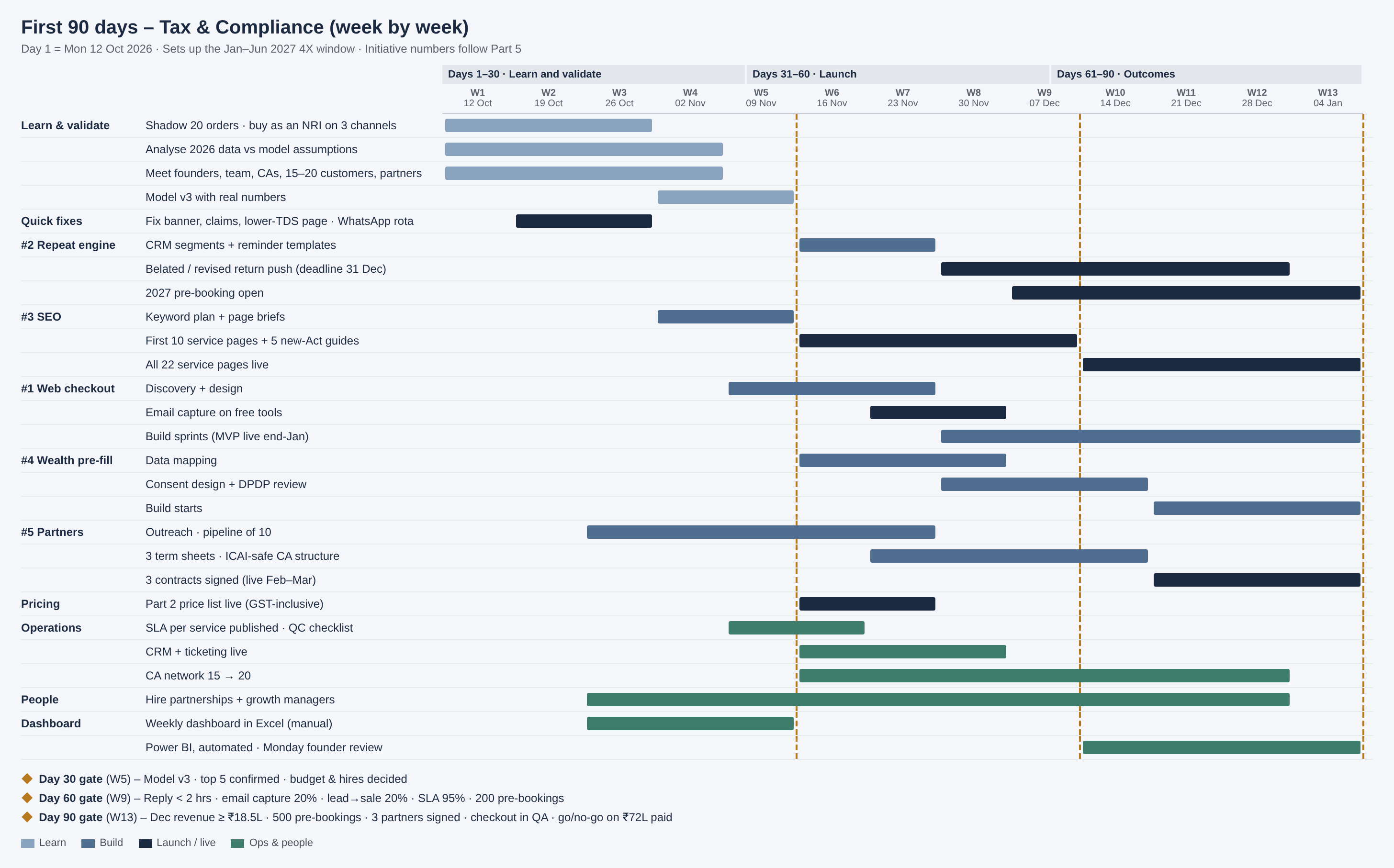
Days 1–30: learn and validate
Check the model against facts
Orders, prices, CA payouts and refunds for 2026, month by month. Where the real number differs from an assumption in the model, change the model.
Founders, team, CAs, customers, partners
The founders on what they will and will not do; the team doing the work; 15 to 20 customers; the CAs; and the first partners to approach.
Weeks 2–3
Remove the stale July banner, make claims agree, repair the lower-TDS page, set a WhatsApp reply rota. I will also shadow 20 orders and buy as an NRI on three channels to feel the experience.
Days 31–60: launch
Start the work that takes longest and ship the quick wins. Repeat engine: CRM groups and reminder messages. SEO: the first 10 service pages and five new-Act guides. Checkout: design, then email capture on the free tools. Pre-fill: data mapping and consent design. Partners: pipeline of ten, three term sheets. New prices go live. Service levels per service are published. CRM and ticketing tools are in. The CA network grows from 15 towards 20.
Days 61–90: outcomes
Help customers who have not yet filed (late returns can be filed until 31 December 2026, and any return can be corrected until 31 March 2027) and open pre-booking for 2027. Checkout build sprints run towards a January release. All 22 service pages go live. Three partner contracts are signed. The dashboard moves from Excel to automated reporting.
Why ₹18.5 L for December? The baseline December is ₹17.4 L. A target of ₹20 L would require a jump that the first 90 days cannot realistically deliver, and a target nobody believes stops being a target. ₹18.5 L is a sign the engine has started, not the proof that 4X will work.
What I would ask the founders on Day 1
- Full 2026 order, price and CA payout data, and access to the order database and ad accounts.
- Approval to fix the site claims and banner this month, before any new campaign.
- Hiring approval for a partnerships manager and a growth manager.
- Introductions to the three or four partners and the CAs who work with SB NRI today.
- A date to decide on the ₹72 L paid budget, tied to the Day 90 gate.
The quarter after: January to March 2027
The 4X plan needs ₹2.39 cr of revenue in January to March. Priorities: ship checkout; run the US tax season (returns due 15 April, FBAR the same date); get customers with a mistake in a filed return to correct it before 31 March (an updated return, ITR-U, can still be filed for up to 48 months); grow the CA network from 20 to 28; and prepare for July, when the first returns under the new Act are due on 31 July 2027.
What I would verify first
The model is only as good as its inputs, and several are my estimates. In the first month I would check these, in this order:
- Real 2026 orders, prices and CA payouts, against the baseline (about 8,050 orders, ₹3.56 cr).
- The share of wealth customers who buy tax help today (12% assumed) and of app users (0.8%).
- Whether the CA network can really grow from 15 to 40 by June, and what it costs.
- What customers will pay: the new prices are tested against competitors, not yet against SB NRI buyers.
- The legal items: DPDP consent for pre-fill, ICAI rules on fee sharing, and GST treatment of export services.
- The new Income-tax Act 2025 details, including form numbers and whether new-Act utilities arrive by April–May 2027.
I would also confirm every rate and date in this page against the official sources below before it is used in a customer message.
Plain-English glossary20 terms
- 4X, season-adjusted
- Four times the 2026 revenue, measured by scaling April–June 2027 up to a full year using the normal seasonal pattern.
- BAU
- Business as usual: the case where nothing new is done.
- EBITDA
- Operating profit: revenue less all running costs, before interest, tax and depreciation.
- Gross / contribution margin
- Gross margin is revenue less the direct cost of delivering the work (CA fees, government fees). Contribution margin also deducts payment, support, refund and marketing costs.
- CAC, LTV
- Cost to win a customer, and what a customer is worth over three years of gross margin.
- TAM, SAM, SOM
- Total market, the part SB NRI can realistically serve, and the part this plan wins.
- ROAS, CTR
- Sales per rupee of ad spend, and the share of people who click an ad they see.
- SLA, TAT, CSAT
- Delivery promise met, turnaround time, and customer satisfaction rating.
- TDS
- Tax deducted at source: tax withheld before money reaches the NRI, often refundable.
- DTAA, Form 10F, Form 67
- The India tax treaty with another country, the form to claim treaty rates, and the form to claim credit for foreign tax.
- RNOR
- Resident but not ordinarily resident: a middle residential status with special tax treatment.
- AIS / 26AS
- The tax department's record of a person's income and tax paid. Mismatches cause notices.
- FBAR
- US report of foreign bank accounts.
- ITR-U
- Updated return: a way to file for a year that was missed or filed wrongly, allowed for up to 48 months.
- Forms 145/146 (earlier 15CA/15CB)
- Forms needed to send money out of India, as renamed under the Income-tax Act 2025.
- DPDP, ICAI
- India's data-protection law, and the CA regulator whose rules limit fee sharing.
- Wealth customers
- People who hold mutual funds or other investments through SB NRI.
- Compliance Score
- SB NRI's in-app score of an NRI's tax and compliance position.
- Zero-rated (GST)
- A service exported to a customer abroad, on which no GST is charged.
- CRM
- The tool that stores customers and sends them messages.
Where the facts come from
SB NRI (public pages, read 9 Oct 2026)
Tax law
Market data
Competitors
- Public pricing pages of ClearTax, Tax2win, Quicko, TaxBuddy, Belong, IndiaForNRI, Savetaxs and ITR Kendra, read October 2026.
© 2026 Harsh Gandhi. All rights reserved. This work is the author’s own. Company names refer to public information. Not legal, tax or investment advice.
Need a growth plan with the numbers behind it?
I help founders and teams turn ambiguous problems into launch-ready plans.